Designing and manufacturing a commercial custom backpack line demands a technical understanding of textiles, stress-point engineering, and quality control. Whether you are launching an outdoor adventure pack, a sleek business commuter bag, or tactical gear, sourcing directly from China maximizes your margin potential. This factory-backed guide breaks down the essential process so B2B buyers avoid costly manufacturing errors.
Step 1: Select the Right Technical Fabrics for Custom Backpack Production
The foundation of any successful bag project begins with selecting the correct outer textile, backing coating, and interior lining weight. Denier (D) measures linear mass density: higher denier ratings provide elevated puncture and abrasion resistance, but increase the raw bag's tare weight.
The following engineering comparison matrix outlines the most common backpack fabrics utilized at Huafang Bags for global brand programs:
📊 Backpack Outer Fabric Technical Comparison & Sourcing Matrix
| Fabric Type | Denier & Weave | Water Resistance Coating | Abrasion Rating (Martindale) | Unit Cost Tier | Ideal Application |
|---|---|---|---|---|---|
| 600D Polyester | 600D x 600D Plain | PU Coating (800mm) | 15,000+ Cycles | $ (Budget) | School bags, promotional backpacks, lightweight everyday carry |
| 900D Oxford Polyester | 900D x 900D Twill/Dobby | Double PU Coating (1,500mm) | 35,000+ Cycles | $$ (Mid-Premium) | Sports backpacks, technical daypacks, gym fitness bags |
| 1000D Cordura Nylon | 1000D Air-Textured Nylon | Polyurethane & DWR (2,000mm) | 80,000+ Cycles | $$$$ (Elite Heavy-Duty) | Tactical military packs, high-altitude trekking, extreme outdoor gear |
| TPU Waterproof Composite | 840D Nylon + TPU Film | Seamless Lamination (10,000mm+) | 50,000+ Cycles | $$$$ (Specialty) | Kayaking dry bags, marine packs, fully submersible waterproof backpacks |
| Certified RPET Fabric | 600D/900D Recycled PET | Water-Based PU (1,000mm) | 25,000+ Cycles | $$ - $$$ (Eco-Certified) | Sustainable corporate merchandise, eco-friendly urban commuter bags |
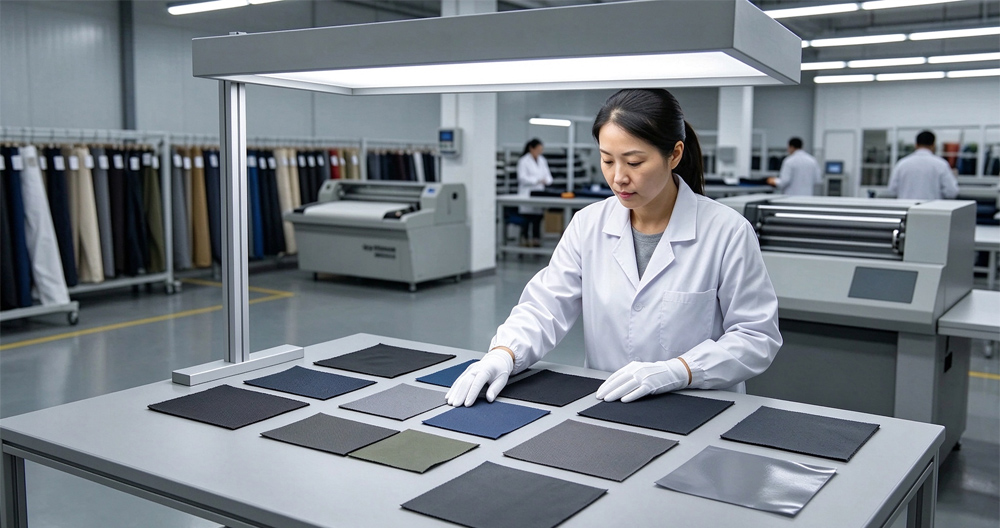
At Huafang Bags, our fabric sourcing warehouse inspects all incoming fabric bolts under calibrated light boxes to eliminate dye lot variations. We also perform random tear testing and hydrostatic pressure verification before any fabric lot is released to the computer-aided laser cutting floor.
💡 Q: How do B2B buyers choose between polyester and nylon for custom backpacks?
A: Nylon offers superior tensile strength, higher elasticity, and significantly better abrasion resistance (ideal for heavy-duty outdoor and tactical bags), but costs 20% to 35% more than polyester. Polyester provides excellent dimensional stability, superior resistance to UV fading, lower moisture absorption, and easier sublimation printing, making it the most cost-effective choice for urban, school, and promotional backpacks.
Step 2: Partner with a Specialized Waterproof Backpack Manufacturer
Partnering with a specialized waterproof backpack manufacturer is vital if your product line serves commuters, hikers, or sports enthusiasts exposed to heavy rain or water activities. Many low-tier factories claim 'waterproof' status while merely spraying fabrics with cheap silicone mist that degrades after three months of use.
Huafang Bags achieves true weather resistance through four integrated structural engineering techniques:
High-Frequency RF Welding: Bonding thermoplastic polyurethane (TPU) panels with molecular radio-frequency welding to create 100% airtight and watertight seams.
Heat-Sealed Seam Taping: Applying multi-layer polyurethane seam sealing tape over interior needle stitching holes to prevent water seepage under continuous downpours.
Waterproof Reverse Coil Zippers: Utilizing PU-coated laminated waterproof zippers (SBS or YKK AquaGuard) combined with welded zipper garages that protect puller entries.
Roll-Top Closure Geometry: Utilizing dual-fold roll-down buckle systems that eliminate top zipper vulnerabilities for marine and wet-weather cycling applications.
Step 3: Design Practical Features and Protective Details for Custom Waterproof Bags
Whether catering to daily commuters facing sudden downpours or outdoor enthusiasts participating in water sports and river tracing, practical protection is the key purchasing factor. Building a market-competitive custom waterproof backpack requires striking a perfect balance between structural waterproofing, ergonomic carrying comfort, and efficient organization.
When contracting Huafang Bags, B2B buyers can select standardized protection solutions built for all-weather outdoor and daily commuting demands:
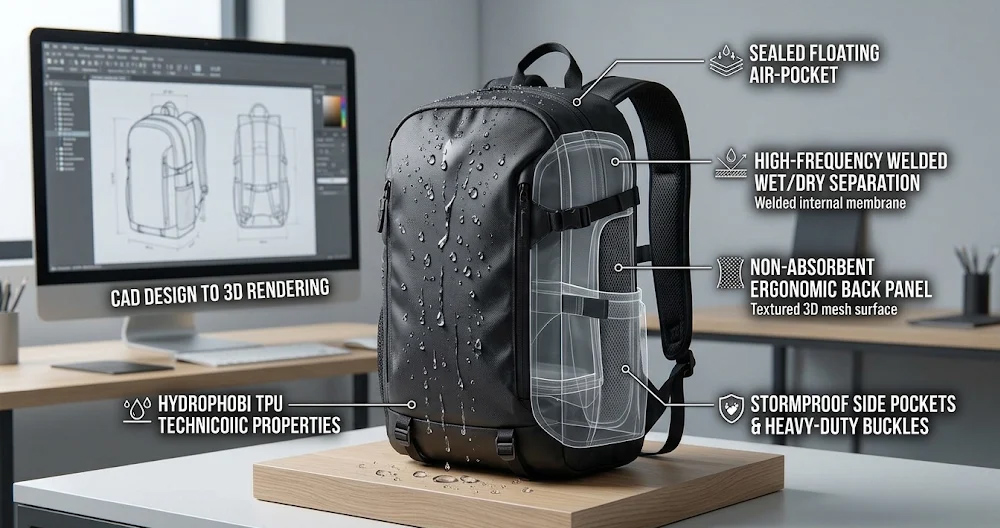
Sealed Floating Air-Pocket Compartment: High-density TPU composite fabric combined with an airtight structural design forms a natural pressure-resistant air cushion inside the main compartment. This allows the bag to float briefly if dropped into water, effectively preventing interior clothing and gear from getting soaked.
High-Frequency Welded Wet/Dry Separation: Intelligently engineered internal space featuring seamless water-barrier membranes created via high-frequency heat welding, allowing users to keep clean garments separate from wet towels, swimwear, or rain gear.
Non-Absorbent Ergonomic Back Panel: The back system combines 3D honeycomb mesh for ventilation with a non-absorbent TPU perforated backplate, ensuring efficient sweat dissipation while preventing the pad from soaking up rainwater and gaining extra weight during severe storms.
Stormproof Side Pockets & Heavy-Duty Buckles: Elastic side bottle pockets with protective rain flaps and external attachment loops are paired with low-temperature-resistant engineering buckles, guaranteeing gear stays secure and dry during extreme outdoor weather or high-speed cycling.
Our design team develops comprehensive CAD tech packs and 3D renderings within 48 hours, allowing your marketing team to pre-sell inventory before mass production completes.
💡 Q: What is the typical lead time for custom waterproof backpacks from China?
A: The production timeline at Quanzhou Huafang Bags spans 7 to 15 days for prototype sample creation and 45 to 55 days for bulk manufacturing after sample sign-off. Expedited scheduling is available for repeat orders utilizing pre-stocked fabrics and existing tooling.
Step 4: Enforce Critical Quality Control Standards in Bulk Production
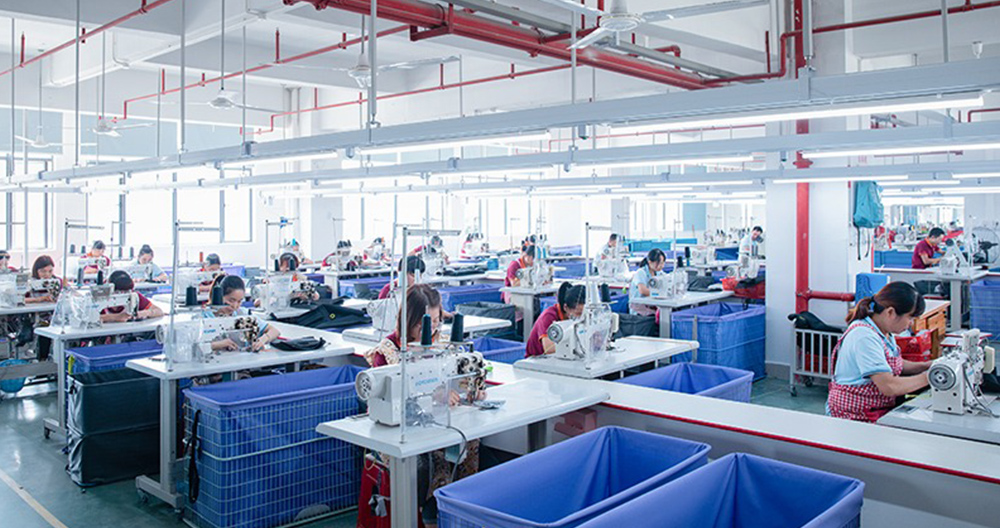
Executing successful custom backpacks bulk production requires stringent quality control at every phase of the manufacturing line. Even minor defects such as misaligned shoulder strap bartacks can lead to high return rates and damage a brand's hard-earned market reputation.
Huafang Bags enforces a strict 4-stage Quality Inspection Protocol governed by international AQL 2.5 Major / 4.0 Minor benchmarks:
Incoming Quality Control (IQC): Every fabric roll undergoes 4-point fabric inspection for weaving defects, color consistency under D65 lighting, and thickness tolerance (±5%).
In-Process Quality Control (IPQC): Roaming inspectors audit stitch density (aiming for 7-8 stitches per inch), tension balancing, and verify that all load-bearing stress points feature double bartack box stitching.
Hardware & Tensile Testing: Random shoulder strap and top haul handle pull-testing on calibrated digital tensile machines, requiring withstand ratings of 25kg to 35kg sustained deadweight load.
Final Quality Control & Outgoing QC (FQC/OQC): 100% cosmetic cleaning (trimming loose threads), zipper operational cycling (minimum 5,000 smooth zips), hydrostatic leak testing, and carton drop-testing according to ISTA-1A standards.
Because Huafang Bags is audited and certified by BSCI, ISO9001, Walmart, Sedex, and Disney FAMA, our inspection logs are fully traceable and available to overseas clients upon request.
💡 Q: What quality inspection standards should be specified in a backpack purchase contract?
A: Buyers should explicitly stipulate AQL 2.5 for Major defects (e.g., open seams, broken zippers, wrong fabric color) and AQL 4.0 for Minor defects (e.g., loose thread ends, slight cosmetic marks). The contract should also mandate specific pull-test minimums (e.g., handle and strap bartacks withstanding 25kg for 60 seconds) and compliance with relevant regional safety standards like Prop 65 or REACH.
Step 5: Verify Factory Credentials with Verified Waterproof Backpack Suppliers
Before transferring deposits or issuing purchase orders, vetting overseas waterproof backpack suppliers is essential for mitigating risk. Overseas brands must verify that a manufacturing partner possesses both the technical infrastructure (RF welding machines, hot-air seam sealing units, digital tensile testers) and the ethical compliance records required by global retail regulations.
Brands can verify factory capability and legitimacy through four verification steps:
Request Third-Party Audits: Inspect valid BSCI, Sedex (SMETA), or ISO9001 audit documentation to ensure environmental and labor compliance.
Review Enterprise Retail Licenses: Confirm factory authorizations from major multinational retailers (such as Huafang Bags' compliance approvals with Walmart, Disney FAMA, and Universal Studios).
Evaluate Waterproof Testing Equipment: Ensure the factory maintains in-house hydrostatic pressure testers (capable of testing 5,000mm–10,000mm+ water heads) rather than relying on external third-party claims.
Validate Raw Material Traceability: Request mill test certificates (MTC) and REACH / RoHS test reports for all TPU films, PU coatings, and hardware fasteners.
💡 Q: How can brands verify factory compliance before placing a bulk backpack order?
A: Overseas brands should request current third-party audit reports from recognized accreditors like BSCI, Sedex (SMETA), or ISO9001. Furthermore, verifying whether the factory holds approvals from strict multinational retailers—such as Huafang Bags' certifications with Walmart, Disney FAMA, and Universal Studios—provides ironclad proof of ethical labor, environmental compliance, and structural manufacturing capability.
Step 6: Finalize Tech Packs, Sampling, and Mass Production Execution
The final stage of sourcing custom technical gear involves transitioning your design concept into verified physical inventory ready for global shipping:
Tech Pack & CAD Generation: Submit vector artwork, dimensional specs, color codes (Pantone), and target hydrostatic waterproof ratings to our engineering team.
Physical Prototyping (7–15 Days): Huafang Bags builds an initial physical sample featuring exact production-grade fabrics, custom hardware, and heat-sealed seam taping for client sign-off.
Bulk Production Run (45–55 Days): Upon prototype sign-off and deposit receipt, mass production begins across 11 automated assembly lines.
Pre-Shipment Inspection & Delivery: Final AQL 2.5/4.0 audits are conducted, hydrostatic leakage tests are logged, and cartons are dispatched under direct export protocols.
Partner directly with an established manufacturing leader to scale your brand: 10+ years of technical craftsmanship, 11 automated assembly lines, a 27,000 m² factory area, and a 300 pcs MOQ.
Contact Huafang Bags Today to request fabric swatches, custom quotes, and get your sample dispatched within 7–15 days.
- SurnameKathy
- Company NameQuanzhou Huafang Bags Co.,Ltd.
- E-mail
- TEL+86-18150581265
Sourcing a custom technical bag line directly from an experienced overseas manufacturer allows brands to achieve maximum margin potential while maintaining strict quality control standards. By following a structured approach—from selecting technical fabrics like 900D Oxford or TPU composites to implementing high-frequency RF welding and enforcing strict AQL 2.5/4.0 benchmarks—B2B buyers can effectively mitigate production risks and eliminate common market failures. Partnering with a verified manufacturer such as Quanzhou Huafang Bags Co., Ltd. ensures full compliance, rapid 7–15 day prototyping, and seamless mass production, empowering your brand to deliver high-performance waterproof gear to global markets with confidence.